scVDJ Parameters
DNBelab C Series HT scVDJ Parameter Configuration Guide
Overview 
This document explains the parameter definitions, default behaviors, and standard usage patterns for dnbc4tools vdj, covering single-cell TCR / BCR immune repertoire full-length assembly and clonotype identification.
Tip: Parameter specifications are based on current command-line help outputs. Examples can be used directly as operational templates.
Main Analysis Workflow (run) 
Usage 
dnbc4tools vdj run \
  --name sample1 --fastqs /data/tcr \
  --ref human --chain TR \
  --beadstrans /results/rna/outs/singlecell.csv \
  --threads 20
Full Command-Line Help
$ dnbc4tools vdj run --help
dnbc4tools 3.2

Process a single-cell V(D)J sample.

Usage: dnbc4tools vdj run [OPTIONS]

options:
  --help                       show this help message and exit

Input Files:
  Choose one input method: either `--fastqs` (directory input) or individual FASTQ files (`--fastq1` and
  `--fastq2`).

  --fastqs <DIR>               Input directory path containing paired-end FASTQ files (e.g., `./fastq_dir`).
  --fastq1 <FILE>              Read 1 FASTQ file path(s). Wildcards and comma-separated lists are supported (e.g.,
                               `sample1_L01_R1.fastq.gz,sample1_L02_R1.fastq.gz`).
  --fastq2 <FILE>              Read 2 FASTQ file path(s). Must match the order provided to `--fastq1` (e.g.,
                               `sample1_L01_R2.fastq.gz,sample1_L02_R2.fastq.gz`).

Basic Settings:
  --name <STR>                 Unique identifier for the sample. Used for naming output files and reports (e.g.,
                               `sample1`).
  --ref <STR>                  Reference database: `human`/`mouse`, or a custom reference directory path containing
                               `reference.json` (e.g., `human` or `./custom_vdj_ref`).
  --chain <STR>                VDJ receptor type: `IG` (BCR) or `TR` (TCR) (e.g., `TR`).
  --outdir <DIR>               Output directory path for results and reports [default: current directory] (e.g.,
                               `./output`).
  --threads <INT>              Number of CPU threads for parallel processing [default: all available cores].
  --beadstrans <FILE>          RNA-analysis `singlecell.csv` file path for cell filtering and bead merging info (e.g.,
                               `./singlecell.csv`).

Library Settings:
  --darkreaction <STR>         Dark cycle setting for VDJ library. Supported values: `R1`, `unset` (e.g., `R1`).
  --customize <STR>            Custom read structure string. Format: `<type>,<read>:<start>-<end>` joined by `;`.
                               (e.g., `"cb,R1:7-16;cb,R1:23-32;umi,R1:38-47;R1,R1:61-150;R2,R2:1-150"`).
  --enrichment_primers <FILE>  Custom inner enrichment primers file path (one primer sequence per line) (e.g.,
                               `./inner_primers.txt`).

Analysis Settings:
  --keep_all_cells             Retain all cells in analysis without RNA-based filtering.
  --r2_only                    Use only Read 2 sequences for VDJ assembly.
  --sample_read_pairs <INT>    Subsample the specified number of read pairs from input FASTQ file(s) (e.g.,
                               `1000000`).
Parameter Reference Tables
Required & Basic Settings
| Option | Type | Default | Description |
|---|---|---|---|
--name |
String | Required | Unique sample identifier; used as output prefix and report title (e.g., sample_VDJ_001) |
--ref |
String / Path | Required | VDJ reference: built-in human or mouse, or a custom directory path containing reference.json |
--chain |
Choice | Required | Immune receptor type: TR (T-cell Receptor) or IG (B-cell Immunoglobulin) |
--beadstrans |
File path | None | Optional RNA cell table for bead mapping and cell filtering; omitting it automatically enables keep_all_cells |
--outdir |
Directory | ./ |
Root output directory for analysis results and HTML reports |
--threads |
Integer | All cores | Number of CPU threads allocated for parallel processing |
Input Files Options
Choose one input mode: directory-based (--fastqs) or explicit files (--fastq1 and --fastq2).
| Option | Type | Default | Description |
|---|---|---|---|
--fastqs |
Directory | None | Directory containing paired-end FASTQ files (files reside directly in this directory; paired files auto-detected) |
--fastq1 |
File path | None | Read 1 FASTQ file list (supports wildcards * or comma-separated paths) |
--fastq2 |
File path | None | Read 2 FASTQ file list (order must strictly match --fastq1) |
Tip: Sequencing Consistency & Batch Handling All FASTQ inputs in a single run must originate from the same library batch with identical sequencing modes and dark reaction settings; data from different libraries cannot be mixed. If different sequencing batches of the same library batch exhibit differing dark reaction cycles or read lengths, use the FASTQ trimming tool
fqsubC4to trim reads to match the standard library structure (see Library Structure).
Library Chemistry & Read Structure
| Option | Type | Default | Description |
|---|---|---|---|
--darkreaction |
Choice | auto |
Dark cycle setting: auto, R1, unset (Note: VDJ does not support R1R2) |
--customize |
String | None | Custom barcode, UMI, and read structure string overriding dark reaction settings |
--enrichment_primers |
File path | None | Path to custom inner enrichment primers file (one primer per line) |
Analysis Settings & Tuning
| Option | Type | Default | Description |
|---|---|---|---|
--keep_all_cells |
Flag | Disabled | Retain all assembled barcodes without RNA-based cell filtering (auto-enabled when omitting --beadstrans) |
--r2_only |
Flag | Disabled | Use only Read 2 sequences for VDJ assembly (for libraries where Read 1 carries only barcode/UMI) |
--sample_read_pairs |
Integer | None | Subsample a specified number of read pairs for rapid benchmarking |
Key Parameter Deep Dives
1. FASTQ Directory Structure & Input Rules
The VDJ --fastqs option points to a flat directory containing paired-end files directly:
VDJ_fastq_dir/
├── sample_VDJ_L01_R1.fastq.gz
├── sample_VDJ_L01_R2.fastq.gz
├── sample_VDJ_L02_R1.fastq.gz
└── sample_VDJ_L02_R2.fastq.gz
- Naming detection: Supports standard read patterns
_R1_,_R1,_1,_read1paired with_R2_,_R2,_2,_read2; file extensions support.fastq.gz,.fq.gz,.fastq,.fq. - Individual inputs: If not using
--fastqs, supply paired files via--fastq1and--fastq2with comma-separated file lists.
2. Cross-Omics Cell Linkage via --beadstrans
--beadstrans is a pivotal parameter for multi-omics integration, linking V(D)J clonotypic assemblies directly to 5' scRNA expression profiles:
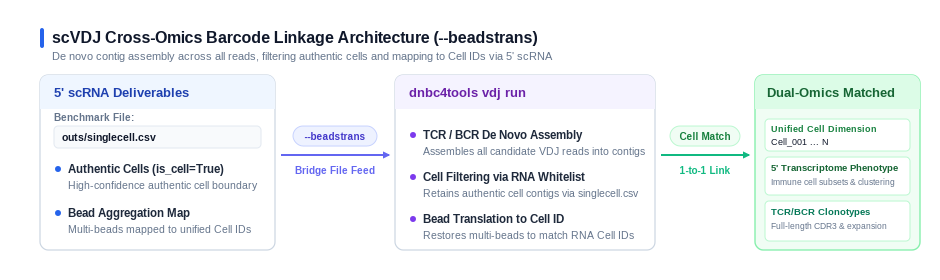
- Input source: Provide the
outs/singlecell.csvfile generated from the corresponding 5' scRNA analysis (supports.csv.gzfrom C6 multi-sample pipelines). - Core Mechanism: The pipeline performs comprehensive de novo assembly across all candidate VDJ reads. Subsequently, during the cell filtering and barcode translation stage, the pipeline applies the authentic cell whitelist from
singlecell.csvto retain genuine cell contigs and translate bead barcodes into unified Cell IDs, outputtingfiltered_contig_annotations.csvmatched with 5' scRNA. - Behavior when omitted: If
--beadstransis omitted, bead merging and cell filtering are skipped, and--keep_all_cellsautomatically engages to retain all assembled barcodes. - Recommendation: In paired 5' RNA + VDJ experiments, always provide
--beadstransto ensure clean clonotype-to-cell mapping and filter technical ambient noise.
3. Reference Databases (--ref) & Receptor Chains (--chain)
- Reference Database (
--ref): - Built-in options:
humanormouse(loads bundled V/D/J/C reference sequences). - Custom database: For other species, specify a custom directory path containing
reference.json, V/D/J/C sequences, and primer configurations (compatible with Cell Ranger VDJ reference databases). - Receptor Type (
--chain): TR: T-cell Receptor (TRA, TRB, TRG, TRD chains).IG: Immunoglobulin (IGH, IGK, IGL chains).
4. Dark Reaction & Custom Read Structure 
Library Structure Reference: For complete VDJ library linker sequences, TSO regions, and dark reaction schematics, see Library Structure.
- Dark Reaction (
--darkreaction): VDJ libraries support only Read 1 dark cycles or unset: auto: Automatically inferredR1: Read 1 contains dark cyclesunset: No dark reactions- Note:
R1R2is invalid for VDJ. - Custom Read Structure (
--customize):# Standard VDJ structure example: Barcode 1 (1-10bp) + Barcode 2 (11-20bp) + UMI (21-30bp) in R1 --customize "cb,R1:1-10;cb,R1:11-20;umi,R1:21-30;R1,R1:31-120;R2,R2:1-150"
5. Custom Inner Enrichment Primers (--enrichment_primers)
For non-human/non-mouse custom species or modified library protocols, provide an inner enrichment primer file (plain text, one primer sequence per line):
GTCCTCGGTGGCCTCCACGTG
AGCACCTGGGGCCTCGGCCAC
CCTGGACTCCTGGGCCCCAG