Library Structure
DNBelab C4 series single-cell technology encompasses three major omics platforms: scRNA-seq (transcriptome), scATAC-seq (chromatin accessibility), and scVDJ (immune repertoire). Each library features specialized physical architectures, adapter compositions, cell barcodes (CB), and unique molecular identifiers (UMI).
This document provides a comprehensive reference for physical library architectures, base coordinate intervals, invariant linker sequences, and --customize parameter configurations across all modalities.
1. scRNA-seq Library Structure 
DNBelab C4 single-cell RNA sequencing consists of two complementary libraries: the cDNA library and the Oligo library. The cDNA library captures transcript expression profiles, while the Oligo library records bead barcodes within droplets for cell calling and doublet discrimination.
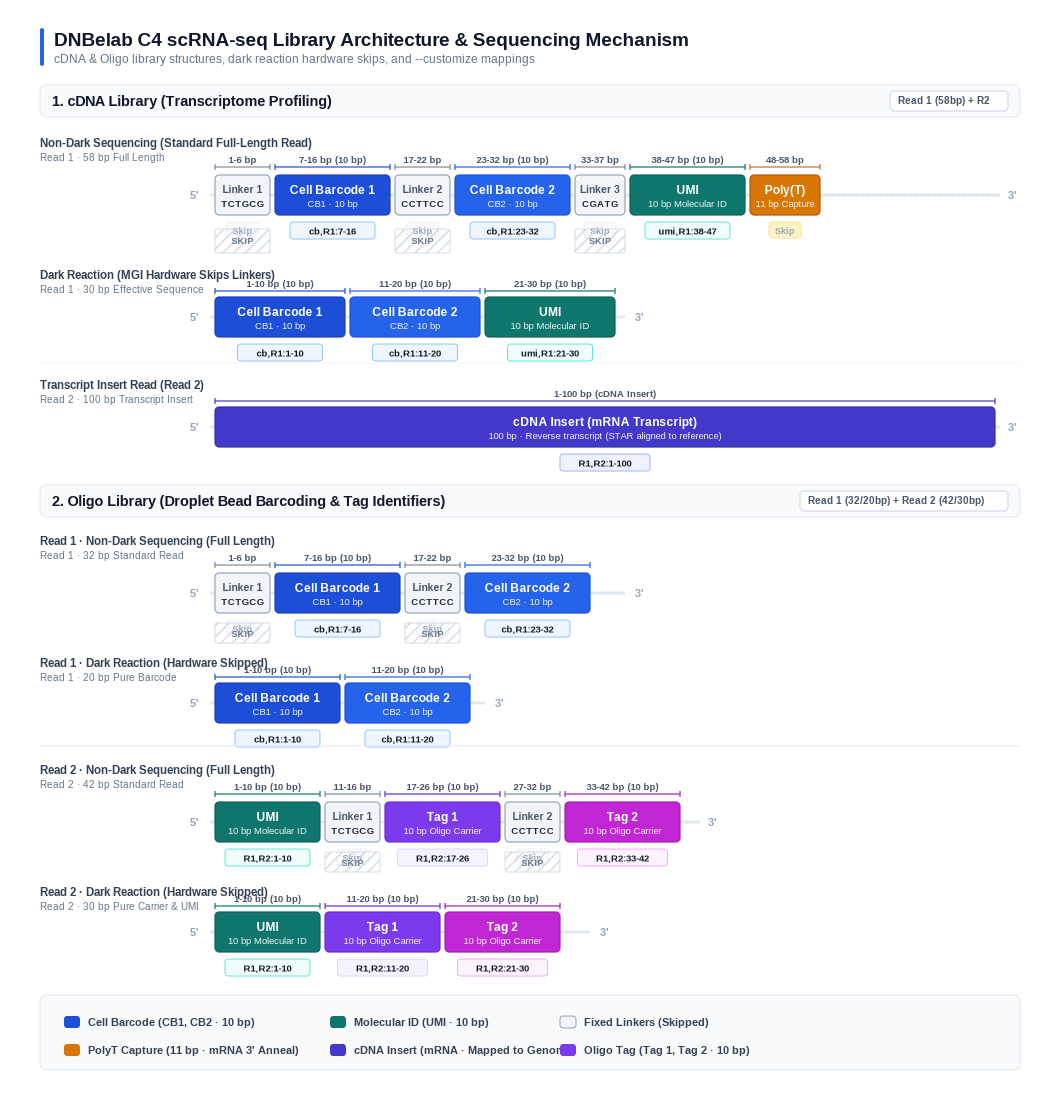
cDNA Library
The cDNA library quantifies gene expression profiles across single cells.
- Read 1 (58 bp):
- Linker 1 (Fixed linker 1, 6 bp):
TCTGCG(1–6 bp, present in non-dark sequencing only) - Cell Barcode 1 (CB1, 10 bp): First cell barcode segment (Non-dark: 7–16 bp; Dark reaction: 1–10 bp)
- Linker 2 (Fixed linker 2, 6 bp):
CCTTCC(17–22 bp, present in non-dark sequencing only) - Cell Barcode 2 (CB2, 10 bp): Second cell barcode segment (Non-dark: 23–32 bp; Dark reaction: 11–20 bp)
- Linker 3 (Fixed linker 3, 5 bp):
CGATG(33–37 bp, present in non-dark sequencing only) - UMI (10 bp): Unique Molecular Identifier (Non-dark: 38–47 bp; Dark reaction: 21–30 bp)
- PolyT capture region (11 bp): Anneals to the mRNA 3' poly(A) tail
- Read 2 (100 bp): cDNA insert (transcript sequence, mapped to the reference genome)
Oligo Library
The Oligo library resolves bead barcodes co-encapsulated in droplets, distinguishing true single cells from multi-bead background droplets.
Read 1 Structure (20–32 bp)
- Non-Dark Mode (32 bp):
- Linker 1 (6 bp):
TCTGCG(1–6 bp, fixed adapter skipped) - Cell Barcode 1 (CB1, 10 bp): First cell barcode segment (7–16 bp, extracted as
cb,R1:7-16) - Linker 2 (6 bp):
CCTTCC(17–22 bp, fixed adapter skipped) - Cell Barcode 2 (CB2, 10 bp): Second cell barcode segment (23–32 bp, extracted as
cb,R1:23-32) - Dark Reaction Mode (20 bp):
- The sequencer hardware skips fixed Linker 1 and Linker 2:
- Cell Barcode 1 (CB1, 10 bp): 1–10 bp, extracted as
cb,R1:1-10 - Cell Barcode 2 (CB2, 10 bp): 11–20 bp, extracted as
cb,R1:11-20
Read 2 Structure (30–42 bp)
- Non-Dark Mode (42 bp):
- UMI (10 bp): Molecular unique identifier (1–10 bp, extracted as
R1,R2:1-10) - Linker 1 (6 bp):
TCTGCG(11–16 bp, fixed adapter skipped) - Tag 1 (10 bp): First bead carrier tag (17–26 bp, extracted as
R1,R2:17-26) - Linker 2 (6 bp):
CCTTCC(27–32 bp, fixed adapter skipped) - Tag 2 (10 bp): Second bead carrier tag (33–42 bp, extracted as
R1,R2:33-42) - Dark Reaction Mode (30 bp):
- The sequencer hardware skips fixed Linker 1 and Linker 2:
- UMI (10 bp): 1–10 bp, extracted as
R1,R2:1-10 - Tag 1 (10 bp): 11–20 bp, extracted as
R1,R2:11-20 - Tag 2 (10 bp): 21–30 bp, extracted as
R1,R2:21-30
For detailed scRNA command arguments, see scRNA Parameters: Custom Read Structure.
2. scATAC-seq Library Structure 
DNBelab C4 single-cell ATAC sequencing profiles accessible chromatin landscapes. ATAC libraries do not contain UMIs; fragment deduplication and quantification rely on mapped genomic coordinates (cut sites) together with cell barcodes.
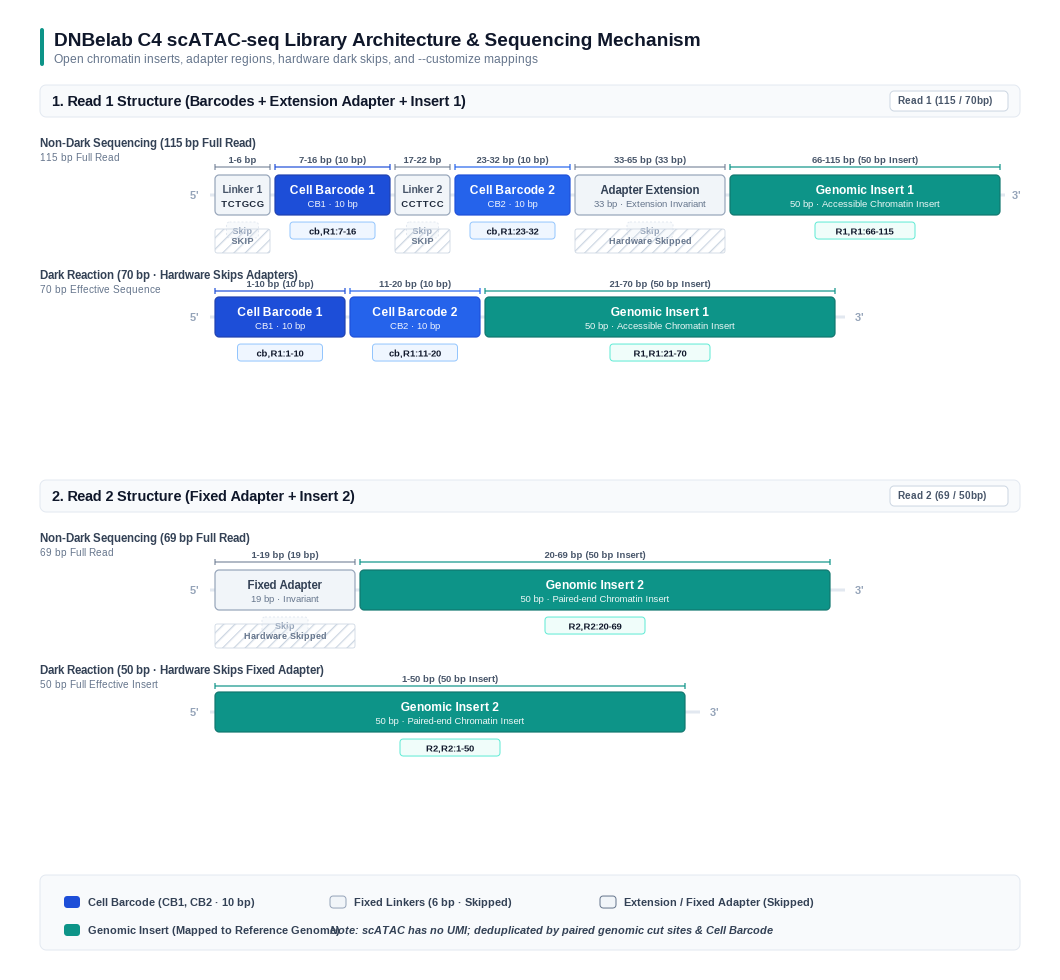
Read 1 Structure (50–115 bp)
- Non-dark reaction mode (115 bp):
- Linker 1 (6 bp):
TCTGCG(1–6 bp, fixed linker skipped) - Cell Barcode 1 (CB1, 10 bp): First barcode segment (7–16 bp, extracted as
cb,R1:7-16) - Linker 2 (6 bp):
CCTTCC(17–22 bp, fixed linker skipped) - Cell Barcode 2 (CB2, 10 bp): Second barcode segment (23–32 bp, extracted as
cb,R1:23-32) - Adapter extension (33 bp): 33–65 bp, invariant adapter extension (skipped)
- Chromatin DNA insert 1 (50 bp): 66–115 bp, genomic DNA insert (extracted as
R1,R1:66-115) - Dark reaction mode (70 bp):
- Sequencer hardware skips Linker 1, Linker 2, and the adapter extension:
- Cell Barcode 1 (CB1, 10 bp): 1–10 bp, extracted as
cb,R1:1-10 - Cell Barcode 2 (CB2, 10 bp): 11–20 bp, extracted as
cb,R1:11-20 - Chromatin DNA insert 1 (50 bp): 21–70 bp, extracted as
R1,R1:21-70
Read 2 Structure (50–69 bp)
- Non-dark reaction mode (69 bp):
- Fixed adapter (19 bp): 1–19 bp (invariant adapter skipped)
- Chromatin DNA insert 2 (50 bp): 20–69 bp, genomic DNA insert (extracted as
R2,R2:20-69) - Dark reaction mode (50 bp):
- Sequencer hardware skips the 19 bp fixed adapter:
- Chromatin DNA insert 2 (50 bp): 1–50 bp, pure genomic DNA sequence (extracted as
R2,R2:1-50)
For scATAC parameter configurations and dark reaction options, see scATAC Parameters: Dark Reaction & Customization.
3. scVDJ Immune Repertoire Library Structure 
DNBelab C4 single-cell V(D)J sequencing utilizes 5' transcript barcoding combined with nested PCR target enrichment for TCR (TRA/TRB/TRD/TRG) and BCR (IGH/IGK/IGL) transcripts, enabling high-fidelity full-length contig assembly and clonotype identification.
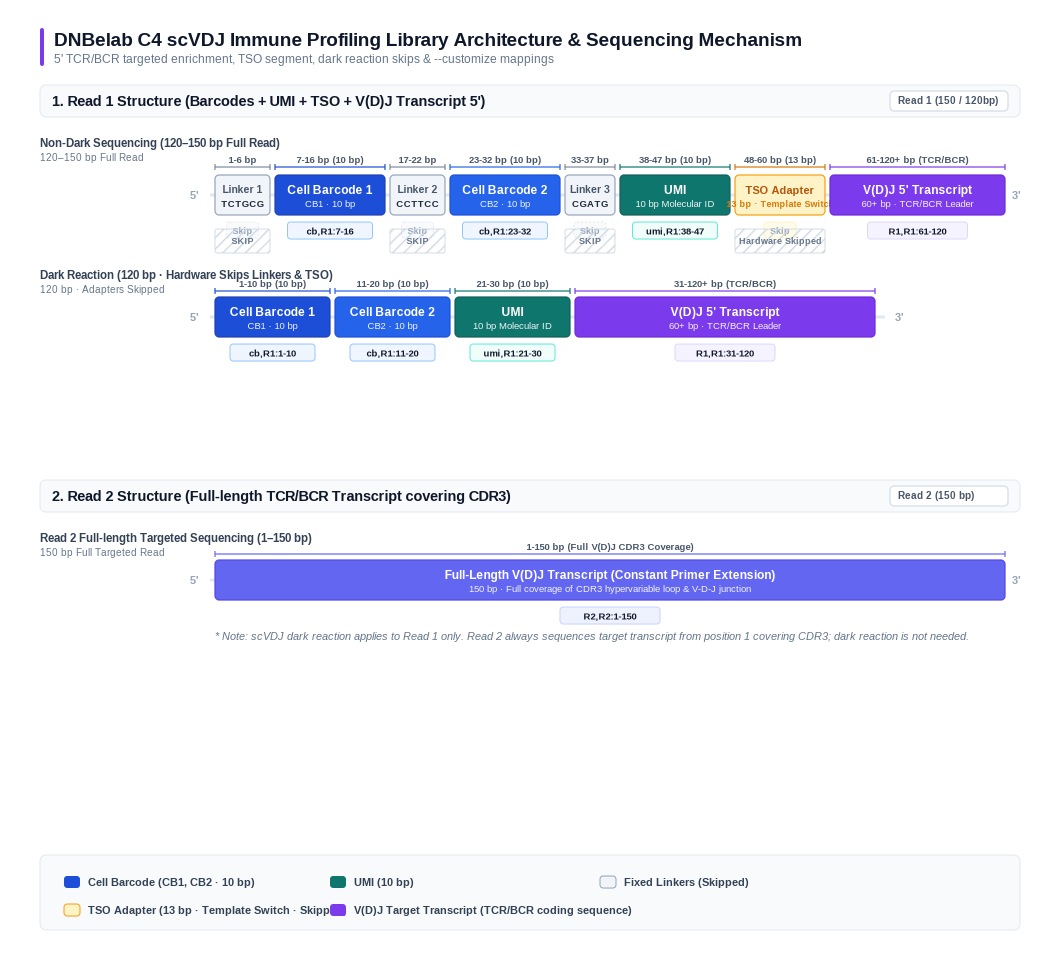
Read 1 Structure (100–150 bp)
- Non-dark reaction mode (120–150 bp):
- Linker 1 (6 bp):
TCTGCG(1–6 bp, fixed linker skipped) - Cell Barcode 1 (CB1, 10 bp): First barcode segment (7–16 bp, extracted as
cb,R1:7-16) - Linker 2 (6 bp):
CCTTCC(17–22 bp, fixed linker skipped) - Cell Barcode 2 (CB2, 10 bp): Second barcode segment (23–32 bp, extracted as
cb,R1:23-32) - Linker 3 (5 bp):
CGATG(33–37 bp, fixed linker skipped) - UMI (10 bp): Unique Molecular Identifier (38–47 bp, extracted as
umi,R1:38-47) - TSO / Extension (13 bp): 48–60 bp, Template Switch Oligo sequence (skipped)
- V(D)J 5' transcript sequence (60+ bp): 61–120+ bp, extracted as
R1,R1:61-120 - Dark reaction mode (120 bp):
- Sequencer hardware skips fixed linkers and TSO:
- Cell Barcode 1 (CB1, 10 bp): 1–10 bp, extracted as
cb,R1:1-10 - Cell Barcode 2 (CB2, 10 bp): 11–20 bp, extracted as
cb,R1:11-20 - UMI (10 bp): 21–30 bp, extracted as
umi,R1:21-30 - V(D)J 5' transcript sequence (90+ bp): 31–120+ bp, extracted as
R1,R1:31-120
Read 2 Structure (100–150 bp)
- Standard reverse transcript sequencing (1–150 bp):
- Read 2 always reads target transcript sequence starting from base 1 (derived from C-region specific primer extension, covering CDR3 and rearranged V/D/J elements), extracted as
R2,R2:1-150. - Note: scVDJ sequencing supports R1 dark reaction or non-dark mode only. Read 2 dark reaction is neither supported nor required.
For scVDJ parameter options and custom structure syntax, see scVDJ Parameters: Dark Reaction & Custom Read Structure.
4. Cross-Modality Library Feature & Configuration Matrix
| Modality | Library Type | Cell Barcode (CB) | UMI Length | Key Invariant Adapters | Supported Dark Reactions | Typical --customize Syntax (Non-dark) |
|---|---|---|---|---|---|---|
| scRNA | cDNA | 2 segments (20 bp) | 10 bp | TCTGCG, CCTTCC, CGATG |
auto, R1, unset |
--customize "cb,R1:7-16;cb,R1:23-32;umi,R1:38-47;R1,R2:1-100" |
| scRNA | Oligo | 2 segments (20 bp) | 10 bp | TCTGCG, CCTTCC |
auto, R1R2, R1, unset |
--customize "cb,R1:7-16;cb,R1:23-32;R1,R2:1-10;R1,R2:17-26;R1,R2:33-42" |
| scATAC | Chromatin Fragment | 2 segments (20 bp) | No UMI | TCTGCG, CCTTCC, Adapter extension, Fixed adapter |
auto, R1R2, R1, R2, unset |
--customize "cb,R1:7-16;cb,R1:23-32;R1,R1:66-115;R2,R2:20-69" |
| scVDJ | TCR / BCR | 2 segments (20 bp) | 10 bp | TCTGCG, CCTTCC, CGATG, TSO |
auto, R1, unset |
--customize "cb,R1:7-16;cb,R1:23-32;umi,R1:38-47;R1,R1:61-120;R2,R2:1-150" |